Film Production Management Software: From Creative Idea to Finished Production
By Filmdoq Team · 2026 Aug 24
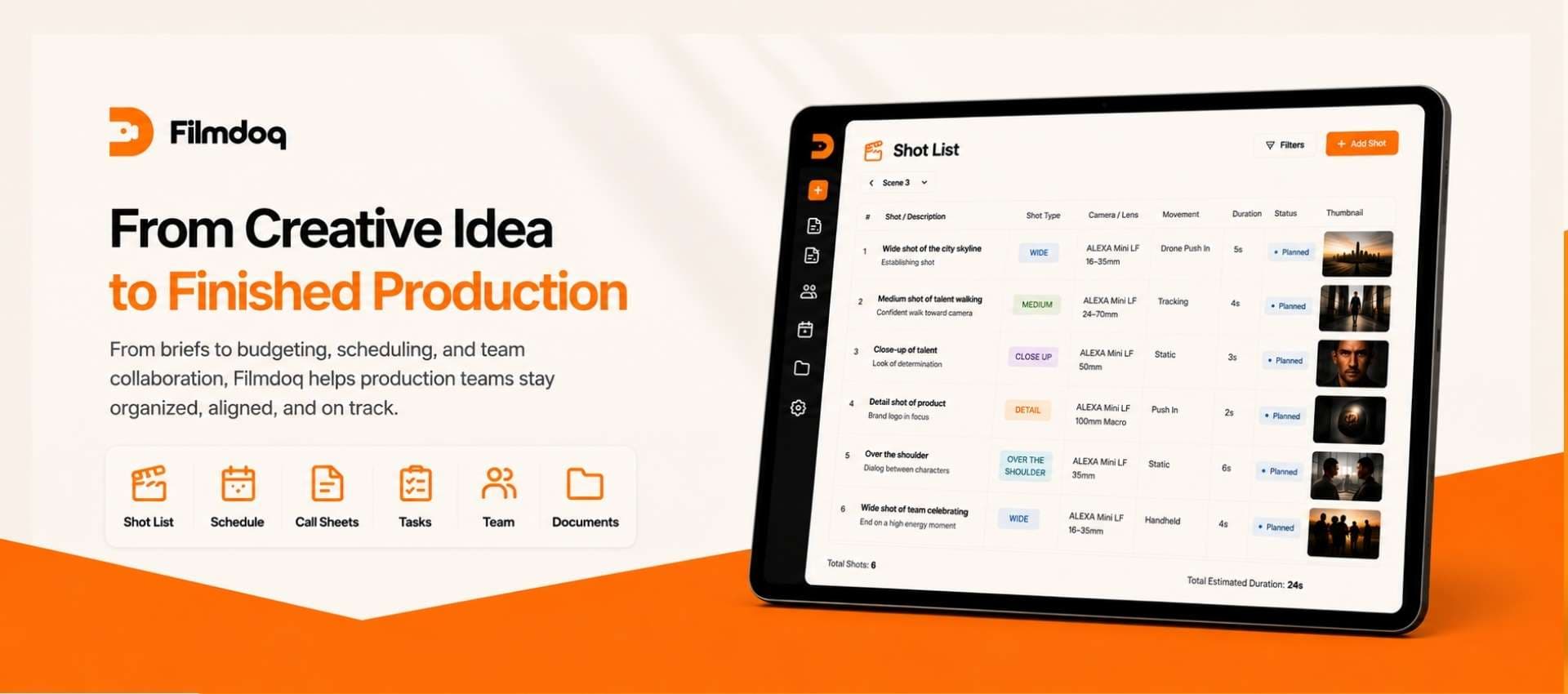
Film production management software is a digital platform designed to help filmmakers, producers, production companies, and creative teams plan, organize, collaborate on, and manage the many moving parts of a production, from the initial creative idea to the finished project.
Instead of keeping your production brief in one document, your budget in a spreadsheet, your shot list somewhere else, your crew information in a contact list, and your production conversations scattered across email and messaging apps, production management software brings these workflows together in one connected workspace.
But why does that matter?
Because a production is rarely just one task. A single project can involve creative development, budgets, clients, crew, locations, equipment, schedules, shot lists, call sheets, contracts, approvals, tasks, invoices, and countless decisions happening at different stages, and as the production grows, so does the possibility of something getting lost.
A client approves the creative direction, but the latest version doesn't make it to the crew.
A location changes, but the shooting schedule still reflects the old one.
A new shot is added, but nobody updates the call sheet.
A crew member asks for the latest schedule while you're trying to find the correct version buried in an email thread.
The problem isn't that filmmakers don't know how to organize a production. The problem is that the production itself is spread across too many places. That's the gap Filmdoq is built to address.
What Is Filmdoq?
Filmdoq is production management software built for filmmakers, video production companies and creative teams to manage a project from the first idea through production and beyond. Instead of managing your production across disconnected spreadsheets, documents, emails, messages and different software platforms, Filmdoq brings the workflow together in one place.
Filmmaking isn't only about cameras, lenses, lighting and great creative ideas. It's also about organizing the hundreds of moving pieces required to turn those ideas into something real. The goal isn't to give filmmakers another piece of software to manage. It's to give the production one place to manage everything.
You can develop creative ideas, build a production brief, create budgets, organize tasks, build shot lists and schedules, prepare call sheets, collaborate with your team, manage contracts and invoices, and keep the production moving all inside Filmdoq.
The Problem Isn't Filmmaking. It's Everything Around Filmmaking.
Ask a filmmaker what they love about their job.
They probably won't say:
“I really enjoy updating spreadsheets.”
They'll talk about storytelling, cinematography, directing, working with talented people and creating something that didn't exist before. But as a production grows, the creative work becomes surrounded by administrative tasks.
A client email here.
A Google Doc there.
A budget spreadsheet somewhere else.
A WhatsApp message from the cinematographer.
A PDF call sheet.
A different document containing the shot list.
A contract sitting in an inbox.
Then someone asks:
“Which version is the latest?” And everyone starts searching.
The production itself might be organized in your head, but the information needed to execute it is scattered everywhere else.
Your Film Production Document Shouldn't Live in 12 Different Apps
Imagine you're producing a commercial. The client approves the concept on Monday, the location changes on Tuesday, the budget changes on Wednesday, and by Thursday, one of your crew members becomes unavailable. By Friday, the shot list has changed and the client wants another deliverable.
None of these changes are unusual, that's production. The problem is what happens next: you update the spreadsheet, then the schedule, then the call sheet, message the crew, email the client, and eventually someone opens an old version.
This is why video production management software matters. The objective isn't simply to digitize documents. It's to create a connected production workflow where the creative ideas, people, tasks, schedules, budgets and production documents have a relationship with each other.
It Starts Before You Pick Up a Camera
One of the biggest mistakes in production is thinking the project begins when the cameras roll.
It doesn't. It begins with the idea.
A client might say: “We need a video for our new product.”
That's not yet a production. It's a starting point.
Before you can create a budget, schedule a crew or build a shot list, you need to understand what you're actually making.
Who is it for?
Why are you making it?
What should the audience feel?
What's the story?
What's the visual direction?
What are the deliverables?
What does success look like?
That's where the Production Brief comes in.
Filmdoq Production Brief can become the creative starting point for your project, giving you and your team a structured place to develop ideas before turning them into production.
And this matters enormously when you're working with clients, because clients don't necessarily buy cameras. They buy ideas, outcomes and the confidence that you understand what they're trying to accomplish.
Film Production Software Should Help You Win the Project, Not Just Manage It
This is an important distinction.
Production management shouldn't begin after the client signs the contract. It can begin while you're still developing the idea. A strong production planning software workflow can help you move through:
Idea → Creative Brief → Client Approval → Budget → Production Plan → Crew → Schedule → Shoot → Delivery
That means your production workspace can start as a pitching tool and eventually become the operational workspace for the actual project. The same creative foundation you use to communicate the project can lead into the practical work required to produce it.
Then the Real Production Work Begins
Once the client approves the concept, it's time to make it happen, and that's where things can quickly get complicated. You need a budget, crew, equipment, locations, a shot list, a shooting schedule, assigned tasks, contracts, and a call sheet. Suddenly, that simple creative idea has become a production with dozens of moving parts. This is where film production project management becomes critical: the creative vision needs to be transformed into an executable plan, and Filmdoq is designed to help bridge that gap.
From Production Brief to Budget
The creative concept determines what the production needs. If the brief calls for:
Multiple locations
A large cast
Specialized equipment
Production design
Multiple shooting days
Extensive post-production
then those creative decisions have financial consequences. That's why the budget shouldn't exist separately from the creative conversation. A film production budget should reflect what you're actually trying to create. With Filmdoq, the budget can become part of the same production workflow rather than an isolated spreadsheet sitting somewhere on your computer.
The question changes from:
“How much does a video cost?” to: “What does this specific creative idea require to produce?” That's a much more useful conversation.
Then Turn the Idea Into a Shot List
Once the concept is clear, you need to figure out what you're actually capturing.
That's where the shot list comes in.
What scenes need to be filmed?
What shots are essential?
What coverage do you need?
Which locations are involved?
What needs to happen on camera?
What can be captured as B-roll?
A shot list software workflow helps transform the creative vision into something the production team can execute. Instead of the shot list being another disconnected document, it becomes part of the larger production plan.
Then Build the Schedule
Now you know what you need to capture, but when are you going to capture it? This is where a production can either feel organized or completely chaotic. Talent availability, location availability, crew call times, travel, equipment, scene requirements, lighting, meals, and company moves all need to fit together.
Filmdoq production scheduling tool helps turn all those requirements into an actual shooting plan. The goal isn't simply to create a schedule; it's to create a schedule that reflects the production you actually planned.
And Then Comes the Call Sheet
A call sheet clearly tells everyone where they're going, when they need to arrive, who needs to be there, what's being filmed, what the schedule looks like, and who to contact. t's about making sure the people executing the production have the information they need before they arrive on set, so everyone starts the day working from the same plan instead of searching through messages or asking for updates.
Your Crew Shouldn't Have to Ask What's Happening
A production team can include directors, producers, cinematographers, camera assistants, gaffers, sound operators, production designers, makeup artists, editors and countless other specialists. And they're not necessarily working together every day.
That creates another communication problem:
Who's responsible for this?
Is the location confirmed?
Has the client approved the concept?
What's the latest schedule?
Who is bringing the equipment?
What still needs to be done?
With Filmdoq, tasks, production documents and team information can live within the project rather than being scattered across unrelated conversations giving everyone a clearer reference point.
Collaboration Should Happen Where the Work Happens
You've presented the Production Brief to the client. They have feedback.
Instead of:
“Can we make the concept and story feel more natural?”
Then: WhatsApp or Phone call
“Also, can we change the ending as well? We want to highlight the product more boldly as an outro?”
Then another email. Then another document. The feedback becomes scattered.
Filmdoq is designed to bring collaboration into the production workspace, so conversations around the project can stay connected to the work itself.
This matters because creative collaboration is part of production management.
What Happens When You Manage Multiple Productions?
Now imagine you're not working on one project, you're running three. One commercial is in pre-production, a documentary is shooting next week, and a corporate project is already in post-production, while another client is waiting for a proposal. This is where many small production companies start feeling the limitations of spreadsheets and disconnected tools. You don't just need to manage a production; you need to manage your production business.
You need to know:
What's currently in production?
What's waiting for client approval?
What's coming up?
Who is assigned to what?
Which tasks are overdue?
What's happening with budgets?
What needs to be invoiced?
Which projects are moving forward?
That's a much bigger problem than creating a call sheet. It's production operations.
And that's where an all-in-one film production software platform like Filmdoq can become valuable. Filmdoq was designed with production variations in mind:
A freelance filmmaker might need a simple workflow for a small commercial.
A production company might have multiple crew members, clients and projects.
A director might primarily care about creative development.
A producer might live inside budgets, schedules and logistics.
A commercial production might involve clients and approvals at every stage.
A documentary might evolve over months.
The workflow changes.
Filmdoq keeps the idea, people and production moving in the same direction no matter the changes, everyone can be carried along automatically?
Filmdoq Is More Than Production Documents
Filmdoq is designed to help creators and production companies manage the entire journey of a production.
From the moment a client says:
“I have an idea.”
To:
“The project is delivered.”
Filmdoq brings all the workflow together.
The Future of Video Production Is More Connected
The industry is changing. More creators are producing commercial-quality work independently, small production companies are competing with larger agencies, brands are producing more content, and freelancers are managing entire productions themselves. At the same time, clients expect faster communication, budgets are under more scrutiny, production teams are becoming more distributed, and everyone is expected to do more with less.
The answer isn't necessarily hiring more people to manage the administration. Sometimes, it's building a better system—a system where the creative idea doesn't get lost, the budget stays connected to the production, the crew knows what's happening, clients can participate, and production documents aren't scattered across ten different places. Most importantly, the journey from concept to production stays connected.
Start With the Idea. Build with Filmdoq.
Whether you're a freelance filmmaker preparing your next commercial, a producer managing a growing production company, a director pitching a brand film, or a creative team working on a documentary, the production begins long before anyone says:
“Roll camera.”
It begins when the idea becomes clear.
When everyone understands what you're making.
When the client sees the vision.
When the team knows their role.
When the budget reflects the creative.
When the schedule makes sense.
When the production is ready to move.
Filmdoq brings the creative and operational sides of production closer together, giving filmmakers and production teams the tools to plan, collaborate, organize and produce without losing sight of the original idea.