What Is a Production Brief, and Why Should You Use One for Your Next Project?
By Filmdoq Team · 2026 Aug 24
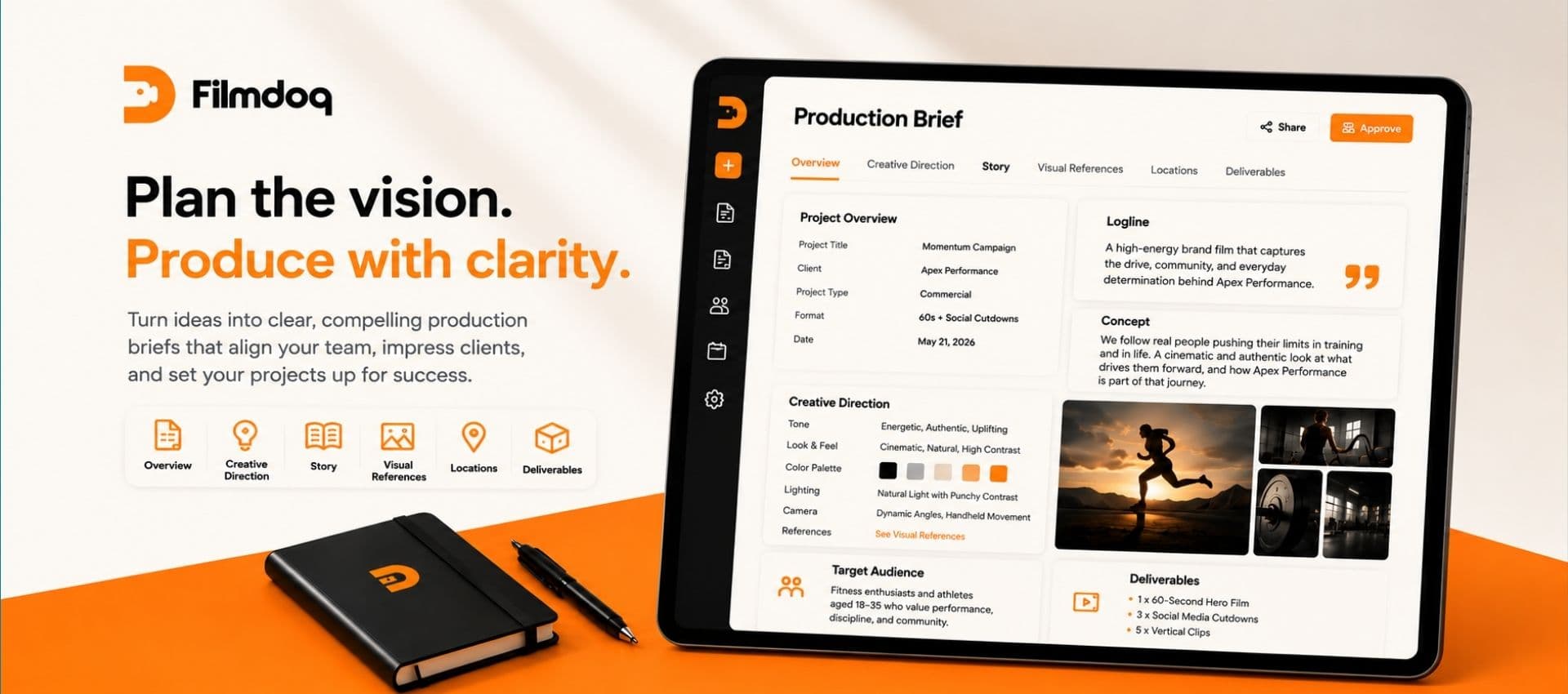
A Production Brief is a document that turns a creative idea into a clear production plan. It brings together the project's concept, story, audience, creative direction, visual references, locations, mood, deliverables, and production requirements in one place.
For filmmakers and creators, it provides a clear creative foundation for developing and producing the project. For clients, it makes the idea easier to understand, visualize, discuss, and approve.
Whether you're pitching a commercial, developing a corporate video, planning a documentary, directing a music video, or making a short film, a production brief answers one fundamental question:
“What exactly are we making, and what should it feel like?”
A client calls you.
They have an idea for a commercial. Maybe it's a 60-second brand film, a social media campaign, or a corporate video that actually feels cinematic.
They tell you:
“We want something emotional, modern and premium.”
You say, “Absolutely.”
Then comes the awkward part.
What exactly does that mean?
What does it look like?
Who is it for?
What's the story?
Where will you shoot it?
What should the audience feel?
Who needs to be involved?
What's the visual direction?
What are the deliverables?
And perhaps most importantly:
How do you turn that conversation into something the client can actually see themselves buying? This is where a production brief becomes much more than a production document. It becomes a creative alignment tool, a pitching tool, a pre-production foundation, and when used properly, a powerful sales tool.
Whether you're producing a commercial for a client, directing a music video, creating a documentary, or developing your next short film, Filmdoq production brief helps turn an idea into something people can understand, approve, and eventually produce.
A Production Brief Turns an Idea Into Something You Can Sell
Most clients don't necessarily know how to communicate a production idea. They know the problem they want to solve. They know their brand. They may have a rough concept in their head, or even have a reference video they love. But they don't always know the filmmaking language required to turn that idea into a production.
That's your job.
A production brief gives you a structured way to take:
“We want to make a video about our new product.”
and turn it into:
“Here's the story, here's the audience, here's the creative direction, here's how it will look and feel, and here's how we're going to bring it to life.”
That's a completely different conversation. You're no longer simply quoting on a video.
You're presenting a vision.
With Filmdoq, you can develop that vision inside a structured Production Brief before moving into the rest of your production workflow. Instead of keeping the concept in scattered emails, notes and conversations, you can give the idea a clear home.
The Difference Between a Quote and a Creative Proposal
Imagine two production companies responding to the same client.
Company A
Commercial Video Production
2-day shoot
4-person crew
Camera package
Lighting
Location
Editing
Colour grading
Total: $12,500
Professional? Sure. But the client may still be asking:
“What am I actually getting?”
Now imagine Company B sends a production brief first.
Concept: A cinematic portrait of the people behind the brand, their mission and their value proposition.
Audience: Young professionals who value craftsmanship and authenticity.
Creative Direction: Intimate, naturalistic and premium.
Visual Style: Handheld camera movement, natural light, shallow depth of field and warm tones.
Locations: The company's workshop, storefront and surrounding neighbourhood.
Story: We follow the founder through a day of work, revealing the people and process behind the product.
Deliverables: A 60-second hero film, three social cutdowns and five vertical clips.
Now the client can see the project before it exists. That's powerful!
A production brief built in Filmdoq can help you present this information in a way that feels like part of the creative process, not simply another document attached to a quote.
Clients Buy What They Can Understand
A client doesn't necessarily want to buy:
“A 4K cinema camera, two shooting days and an editor.”
They want to buy:
“A film that makes our customers understand why our brand is different.”
The production brief helps you make that connection. It shifts the conversation away from equipment and hours and toward:
The idea
The story
The audience
The outcome
The experience
The creative value
That can dramatically change how a client perceives your proposal.
You're no longer competing solely on price. You're competing on vision.
The Production Brief Helps You Close the Deal
This is one of the most overlooked benefits of a production brief.
A strong brief can help a client move from:
“That sounds interesting.”
to:
“Yes, that's exactly what we want.”
Why? Because you're reducing uncertainty.
The client can see that you've thought about their project. You've taken their initial idea seriously. You've developed it. You've considered the audience. You've thought about the visual direction. You've considered how the story will work. Most importantly, you've translated their vague idea into something tangible.
That creates confidence, and confidence is a huge part of getting a client to say yes.
Instead of asking the client to imagine what you're proposing, Filmdoq Production Brief gives you a place to actually build the concept, organize the creative thinking and get the client reacting to something concrete.
Production Brief Makes You Look More Professional
There's a psychological difference between saying:
“I'll send you a quote.”
and saying:
“I'll put together a creative production brief outlining the concept, visual direction, audience, locations and production approach, then we'll build the estimate around it.”
The second one immediately positions you differently. You're not simply someone with a camera. You're a creative production partner.
That's especially important when you're competing for commercial work, where clients may be comparing multiple production companies, agencies, freelancers or creators.
A thoughtful production brief demonstrates that you understand more than cameras and equipment. You understand their problem, their audience and the story you're trying to tell.
Filmdoq can fit naturally into this stage of the process by giving creators and production teams a structured workspace to turn those early conversations into an organized creative proposal.
Start With the Client's Problem
A good production brief shouldn't just describe what you're making. It should explain why you're making it.
Imagine a fitness brand tells you:
“We need a video for our new membership program.”
Instead of immediately jumping into cameras and locations, ask:
Who are we trying to reach?
What do we want them to feel?
What do we want them to do after watching?
Why should they care?
What problem are we solving for them?
Now the production has a purpose. Maybe the answer is:
The campaign should make joining the gym feel less intimidating and more like becoming part of a community.
Suddenly you have a creative direction. The film isn't about showing people lifting weights. It's about belonging. That distinction can completely change the production.
This is where a creative brief for video production becomes valuable. It forces the team to connect the creative idea with the intended audience and outcome before production starts.
The Brief Becomes the Bridge Between the Client and the Crew
Once the client approves the creative direction, the same document becomes incredibly useful internally.
The client sees: The vision.
The director sees: The story.
The cinematographer sees: The visual language.
The producer sees: The production requirements.
The editor sees: The intended emotional experience.
Everyone is now working toward the same thing.
That's one of the biggest advantages of having a production brief as part of your video production workflow. Instead of the creative vision existing only in the director's head or being scattered across emails, messages and meetings it becomes something the team can reference.
With Filmdoq, that creative foundation can sit alongside the other documents and tools needed to take a project from concept to production.
Production Brief Helps Filmmakers Clarify Their Own Ideas Too
This isn't just for commercial productions. If you're making a short film, documentary, music video, branded film or personal project, the same principle applies. Sometimes the person who needs the production brief most is you. You might have an amazing idea but only a vague understanding of what it actually is.
Writing the brief forces you to answer:
What is this about?
Why am I making it?
Who is it for?
What should it feel like?
What does the audience need to experience?
What does the world look like?
What do I actually need to produce it?
Those questions turn an abstract idea into an executable project.
The Brief Can Save You Money
Creative confusion becomes expensive very quickly. Imagine you shoot an entire commercial and discover during editing that the client expected a completely different tone. Now you're talking about:
Reshoots
Additional locations
Additional editing
New music
Additional graphics
More crew days
More client revisions
Many of these problems could have been discovered before production. A production brief gives everyone an opportunity to say:
“Yes. This is what we're making.”
before the production starts spending money.
This is particularly valuable for commercial video production, where changes can quickly affect the budget, schedule, talent, locations and deliverables. By establishing the creative direction early in Filmdoq, you create a clearer reference point for everyone involved.
Visual References Make the Pitch Even Stronger
Words are useful. Images are often better. A production brief can bring the idea to life through visual references.
Show the client:
Lighting references
Camera compositions
Colour palettes
Locations
Wardrobe
Production design
Framing
Camera movement
Performance style
Instead of telling a client:
“We want something cinematic but authentic.”
Show them what that means. Now you're not asking them to imagine your idea.
You're giving them something to react to. This makes creative approvals much easier.
The brief also gives your team a shared visual language once production begins. A reference that helped sell the concept can become the same reference that helps the cinematographer, production designer or director understand the intended direction.
The Production Brief Can Become Your Pre-Production Foundation
Once the client approves the brief, you can build everything else from it.
Production Brief: What are we making?
Budget: What will it cost?
Shot List: What do we need to capture?
Shooting Schedule: When will we capture it?
Call Sheet: Who needs to be where and when?
Contracts: What are everyone's responsibilities?
The brief sits at the beginning because it establishes the creative foundation for everything that follows.
This is one reason a production management platform like Filmdoq can be useful for creators and production companies. The brief isn't an isolated document; it can become the starting point for the rest of the production workflow.
Don't Just Send a Quote. Show Them the Film.
The next time a potential client says: “Can you send me a quote?” Don't make the quote the first thing they see.
Start with the idea. Take what they've told you. Develop it. Give it structure. Show them what the project could look like. Then build the production around that vision.
Because clients don't hire filmmakers simply because they own cameras.
They hire filmmakers because they believe those filmmakers can turn an idea into something worth watching. A production brief is one of the simplest ways to demonstrate that ability.
Build the Vision Before You Build the Production
Whether you're pitching a $5,000 social media campaign, a $50,000 commercial, a documentary, a music video, a corporate film, or your next short film, the principle is the same:
Get the idea clear before you get the production moving.
Define the story.
Define the audience.
Define the creative direction.
Define the mood.
Collect the references.
Clarify the locations.
Establish the production approach.
Then share it.
The best production briefs don't make your creative process more complicated. They make it clearer.
Filmdoq production brief is designed to help give creators and production teams a structured place to develop ideas, collaborate with clients, establish creative direction and move from concept to production.
Because the best productions don't start with:
“How much is this going to cost?”
They start with:
“Here's what we could create together.”