Starting a Video Production Company: 5 Essential Steps
By Filmdoq Team · 2026 Aug 29
Starting a video production company can be an exciting way to turn your filmmaking skills into a profitable business. But owning cameras and knowing how to shoot video is only one part of building a successful production company.
A sustainable video production business requires a combination of creative skill, business strategy, the right equipment, the right team, client relationships, pricing, marketing, and an efficient production workflow.
Whether you want to produce commercials, corporate videos, music videos, documentaries, social media content, weddings, branded content, or independent films, the fundamentals of starting a video production company are largely the same.
Here are five essential steps to help you build the foundation for a successful video production business.
1. Choose Your Video Production Niche
One of the first decisions you should make is what type of video production company you want to build. It can be tempting to say you do everything. But when you're starting out, having a clear niche can make it easier to market your business, attract the right clients, build a relevant portfolio, and understand what equipment and services you actually need.
Some common video production niches include:
Corporate video production
Commercial and advertising production
Music videos
Wedding videography
Documentary filmmaking
Real estate video
Social media content
Product videos
Event videography
Film and television production
YouTube and creator content
Your niche doesn't have to permanently define your company. Think of it as a starting point.
For example, you might begin by producing corporate videos and social media content for businesses, then expand into commercials and larger productions as your portfolio and client base grow.
Why your niche matters
Your niche influences almost every other decision you'll make.
It determines:
What equipment you need
Who your ideal clients are
How you market your company
What your portfolio should look like
How you price your services
Which crew members you need
What type of production software you'll use
How you differentiate yourself from competitors
A clearly defined niche can also make your company easier to find online. Instead of simply marketing yourself as a "video production company," you can target specific searches such as corporate video production company, commercial video production, or music video production company.
2. Build a Professional Portfolio Before Chasing Big Clients
Clients want to know one thing before they hire you:
Can you produce the type of video they need?
Your portfolio is therefore one of your most important sales tools. You don't necessarily need dozens of projects to get started. What matters more is that your portfolio demonstrates the type and quality of work you want to be hired to produce.
If you want to produce commercial videos, your portfolio should showcase commercial-style work.
If you want to work with corporate clients, demonstrate interviews, branded content, corporate storytelling, and polished promotional videos.
If you want to produce music videos, show creative cinematography, lighting, camera movement, and visual storytelling.
Don't wait for clients to build your portfolio
One of the biggest mistakes new production companies make is waiting for paid clients before creating professional work. If you don't have enough client work yet, create your own projects.
You can:
Produce a spec commercial
Create a short documentary
Shoot a product video
Collaborate with local businesses
Produce a music video for an emerging artist
Create social media campaigns for your own company
Collaborate with other filmmakers and creatives
The goal is to create proof of capability. Your portfolio should make it easy for a potential client to imagine what their project could look like in your hands.
3. Invest in the Right Video Production Equipment
You don't need to own every piece of filmmaking equipment to start a video production company.
In fact, buying too much equipment too early can put unnecessary pressure on your cash flow.
A professional camera, lenses, lighting, audio, tripods, stabilization, media, batteries, and other production equipment can quickly become a significant investment. The smarter approach is to build a core production kit around the type of work you actually plan to produce.
Start with the essentials
Depending on your niche, your initial equipment may include:
Camera body
Professional lenses
Tripod
Camera batteries
Memory cards
Lighting equipment
Light stands
Wireless microphones
Camera monitor
Basic grip equipment
Hard drives or SSDs
Production expendables
You don't have to own everything.
Rent equipment when it makes financial sense
One of the advantages of starting a production company today is access to professional camera and video equipment rentals. Instead of spending thousands of dollars buying a specialized cinema camera, cinema lens, large lighting package, or professional grip system that you may only need occasionally, you can rent the equipment for a specific production and build the rental cost into your project budget.
This allows a new production company to offer professional-level production capabilities without having to own an entire rental inventory. The key is to understand the difference between equipment you need regularly and equipment you only need for specific productions.
Buy what you use constantly. Rent what you use occasionally.
4. Develop Your Pricing, Business Model and Client Acquisition Strategy
Being a great filmmaker doesn't automatically make you a great business owner. A production company needs a business model that allows you to cover production costs, pay your crew, replace equipment, cover overhead, and still make a profit.
Understand your production costs
Before giving a client a price, understand what the project will actually cost.
Your production budget may include:
Pre-production
Producer fees
Director fees
Camera crew
Lighting crew
Sound crew
Equipment rentals
Location fees
Talent
Transportation
Catering
Insurance
Production supplies
Post-production
Contingency
Don't simply calculate how many hours you'll spend filming and multiply that by an hourly rate. A professional production quote should account for the entire production process, not just the time spent holding a camera.
Build relationships, not just a client list
Your first clients will often come through your existing network.
Start with:
Previous colleagues
Local businesses
Agencies
Marketing departments
Artists
Event companies
Other production companies
Creative agencies
Entrepreneurs
Community organizations
You should also build a consistent online presence. Your website should clearly communicate:
What you do → Who you do it for → Where you operate → Why clients should hire you.
Your social media can then demonstrate your work, behind-the-scenes production, case studies, client results, and expertise. The objective isn't simply to get followers. It's to make it easy for potential clients to find you, trust you, and contact you.
5. Use Film & Video Production Management Software
This is the step many new production companies underestimate. Once you're managing multiple clients, crew members, locations, budgets, schedules, equipment, documents, and deadlines, simply using email, spreadsheets, WhatsApp messages, and folders can quickly become difficult to manage. This is where film and video production management software becomes important.
Production management software helps production companies organize the operational side of filmmaking, from pre-production through production and, depending on the platform, post-production. Modern production management platforms increasingly combine tools such as budgets, schedules, call sheets, crew management, shot lists, breakdowns, locations, and production documents into connected workflows.
Instead of having your budget in one spreadsheet, your call sheet in another document, crew information in your contacts, and production schedule somewhere else, a production management system can help keep the project organized in one place.
What should production management software help you manage?
At minimum, look for tools that help with:
Production Budgets
Build and manage your production budget, track expenses, and understand where your money is going.
Shooting Schedules
Organize shoot days, scenes, locations, crew requirements, and production logistics.
Call Sheets
Create professional call sheets containing crew information, locations, schedules, weather, logistics, emergency information, and other important production details.
Shot Lists
Plan your shots and keep your creative and production teams aligned.
Crew & Cast
Keep important information about your crew, cast, vendors, and production contacts organized.
Production Documents
Keep your production paperwork, templates, forms, and project information organized instead of scattered across email threads and folders. The goal isn't simply to have another software subscription. The goal is to create a repeatable production workflow.
Where Filmdoq Comes In
This is exactly the problem Filmdoq is built to solve.
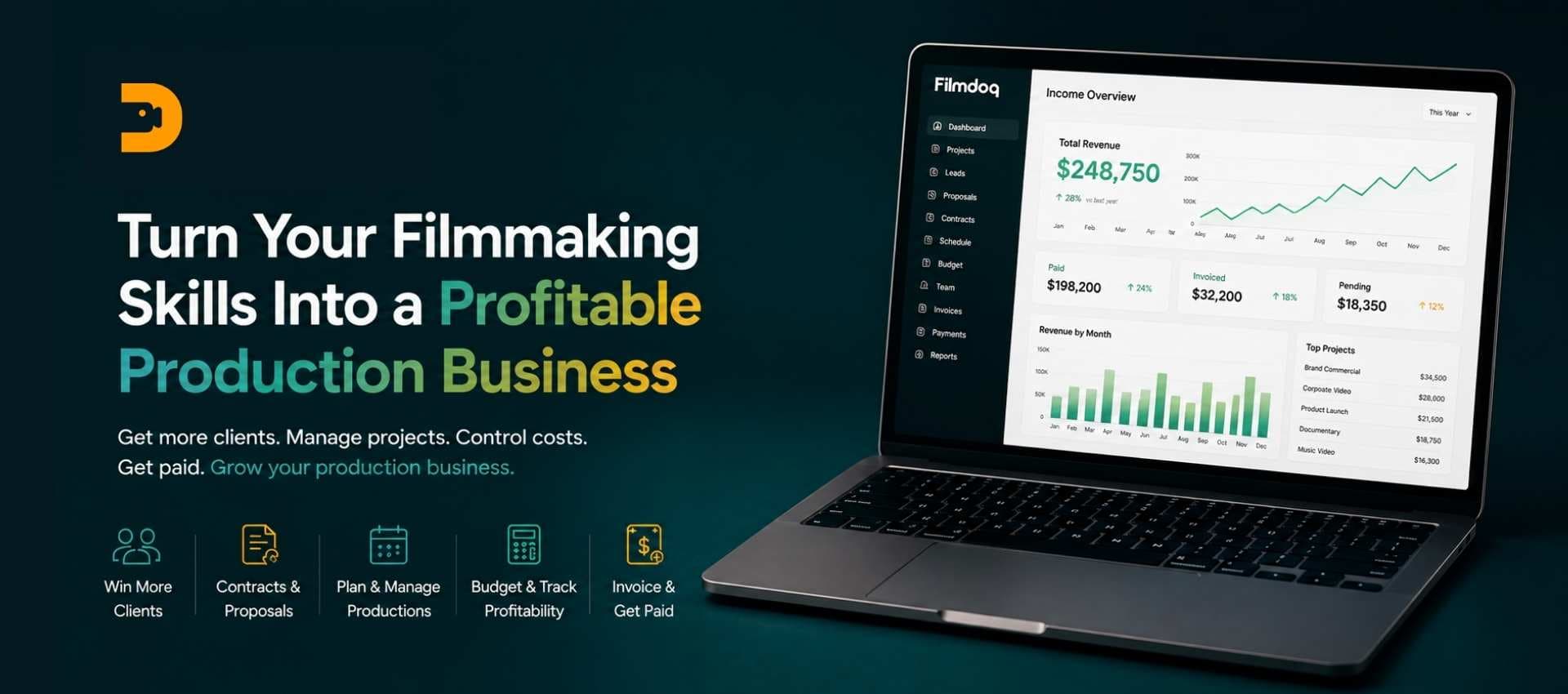
As your production company grows, you don't just need software to create documents. You need a system that helps you plan, manage, produce, and get paid for your productions. Filmdoq brings the essential parts of running a video production business into one platform.
From production briefs and budgets to shooting schedules, call sheets, shot lists, invoices, contracts, and payments, Filmdoq is designed to help filmmakers manage the business and operational side of production without relying on disconnected tools. Instead of creating a production budget in one application, a call sheet somewhere else, tracking your project in spreadsheets, sending invoices through another service, and communicating with your team across multiple platforms, Filmdoq gives you a centralized production workflow.
Build your production from one place
With Filmdoq, production companies can organize key stages of their workflow, including:
Production briefs
Budget breakdowns
Shooting schedules
Call sheets
Shot lists
Production forms
Contracts
Invoices
Payments
Project management
Crew and production information
The bigger idea is connected production management. When information is organized properly, your production team spends less time recreating information and more time actually producing.
Don't Just Start a Video Production Company, Build a Production Business
Starting a video production company is relatively easy.
Building one that is profitable, organized, and scalable is the real challenge.
You need more than a camera.
You need:
A clear niche so you know who you serve.
A strong portfolio that demonstrates what you can produce.
The right equipment strategy so you can produce professionally without unnecessarily tying up your capital.
A sustainable pricing and client acquisition strategy so you can generate consistent revenue.
A production management system that allows you to organize projects and scale your operations.
As you take on larger productions, the complexity increases. More clients mean more budgets. More projects mean more schedules. More crew means more communication. More equipment means more logistics. That's why building your operational systems early can give your production company a significant advantage.
Your camera helps you create the image. Your production system helps you build the business. And if you're serious about turning filmmaking into a scalable production company, getting that second part right can be just as important as getting the first one right.