Turn Your Filmmaking Skills Into a Profitable Production Business
By Filmdoq Team · 2026 Aug 27
Getting paid to make videos is not the same as running a video production business. Here’s how filmmakers, videographers, photographers, and other creative professionals can build a more consistent, profitable, and repeatable business around their skills.
For many filmmakers, the hardest part isn't learning how to operate a camera, edit videos or tell a compelling story. The hardest part is often turning those skills into a consistent and reliable income stream. You might be an excellent filmmaker and still go through months where work is inconsistent. One month you're booked solid. The next month you're wondering where the next client is coming from. You might have the skills, the equipment, the portfolio, and even a growing list of clients, but still feel like you're constantly chasing the next job. That's because being good at production and running a production business are two different things.
A client paying you $5,000 to shoot a video means you've earned $5,000. It doesn't necessarily mean you've built a business. A business needs a system for finding and converting opportunities, defining services, pricing projects, managing clients, planning production, controlling costs, delivering the work, collecting payment, and turning successful projects into repeatable revenue. That's the gap many freelancers and small production companies struggle to bridge, and it's where production management software like Filmdoq can become valuable. Filmdoq helps turn your creative skill into a production business.
The Difference Between a Filmmaker and a Production Business
Imagine a client sends you a message:
"How much would you charge to shoot a corporate video?"
You give them a price.
They agree.
You show up with your camera, shoot the project, edit the footage, send the final video, and get paid.
You've successfully completed a job. But now imagine you have five clients.
One wants a commercial.
Another wants a music video.
Another needs monthly social media content.
You have two shoots happening on the same week.
An editor is working on one project.
A second shooter is helping with another.
One client hasn't paid their deposit.
Another wants additional revisions.
Your equipment needs to be rented.
Your production budget has changed.
And you're trying to remember which version of the contract each client approved.
At that point, the question isn't:
"Can you make a good video?" You already can.
The question becomes: "Can your business consistently manage and profit from making videos?"
That's the transition from doing gigs to running a production business.
Why Consistent Income Is So Difficult for Filmmakers
Creative professionals often experience a feast-or-famine cycle.
You get a project.
You work intensely for two weeks.
You deliver it.
You get paid.
Then you start looking for the next project.
This creates a dangerous cycle:
Find client → Do project → Get paid → Finish project → Find another client
The problem isn't necessarily your creative ability.
The problem is that your business may not have a repeatable system around that ability.
A sustainable production business needs to turn:
Skill → Service → Client → Project → Revenue → Profit → Repeat Business
into a process rather than relying on luck, referrals, or whatever happens to land in your inbox that month. And this is where many filmmakers need to change how they think about their careers.
How to Make Money From Your Filmmaking Skills
One of the biggest mistakes creative professionals make is selling themselves primarily by the hour or by the day.
"I charge $600 for a shooting day."
"I charge $500 for editing."
"I charge $1,000 for photography."
Those numbers aren't necessarily wrong, but a production business should eventually think beyond selling labour.
Instead of:
"I shoot videos."
Think:
"I provide corporate video production."
Instead of:
"I edit videos."
Think:
"I provide post-production services for brands and businesses."
Instead of:
"I take photos."
Think:
"I provide commercial photography packages."
The difference is important.
A skill is something you can perform.
A service is something you can package, price, sell, deliver, and repeat.
Turn Your Skills Into Repeatable Services
Suppose you're a filmmaker who offers corporate video production. Instead of creating a new quote from scratch every time someone asks for a video, you could create a defined service such as:
Corporate Video Package
Pre-production planning
One production day
Two-camera setup
One director/videographer
Professional lighting
Audio recording
Editing
Colour correction
One 60-second hero video
Three social media cutdowns
Two rounds of revisions
Final delivery
Now the client isn't simply buying your time. They're buying a defined outcome. This makes your service easier to explain, easier to price, easier to sell, and easier to deliver. More importantly, it makes it easier to build a business around it.
A Production Business Needs a Commercial Workflow
A professional production doesn't start when the camera starts recording. It starts when someone becomes a potential client.
A healthy workflow might look like:
Lead → Quote → Proposal → Contract → Deposit → Project → Budget → Production → Approval → Invoice → Payment → Delivery → Repeat Business
Without a system, each step may live somewhere different.
Your lead might be in Instagram DMs.
The quote might be in Google Docs.
The contract might be an old Word document.
The budget might be an Excel spreadsheet.
The schedule might be in Google Calendar.
The call sheet might be a PDF.
Crew communication might happen through WhatsApp.
The invoice might be created somewhere else.
And the payment might arrive through another platform.
You can make money this way, but as the number of projects increases, the administrative work starts consuming the time you should be spending selling, producing, and growing the business.
Getting Paid Is Not the Same as Being Profitable
Another major shift happens when you stop looking only at revenue.
A client pays you $3,000.
It feels like a $3,000 project.
But what did it actually cost to produce?
Project Cost:
Client revenue: $3,000
Crew
-$700
Equipment
-$300
Location
-$200
Transportation
-$150
Editor
-$400
Other expenses
-$100
Estimated project profit: $1,150
Your business didn't make $3,000. It generated $3,000 in revenue and approximately $1,150 before considering other business overhead and taxes. That's a completely different number, and this is why production budgeting matters.
Filmdoq's budgeting tools allow production teams to organize estimated and actual costs, track expenses by department, compare budget performance, and monitor project margins.
Revenue tells you how much money came in, while Profit tells you whether the production was actually worth doing.
The Real Goal Isn't More Gigs. It's a Better Business.
If you're constantly chasing another $3000 shoot, you can end up working harder without becoming more financially stable.
The goal should be to build a system that allows you to:
Sell higher-value services
Price projects properly
Know your costs
Protect your margins
Deliver consistently
Build repeat clients
Manage multiple projects
Delegate work
Bring in additional crew
Collect payments reliably
Understand which projects are actually profitable
That is what turns a creative career into a production business.
From Freelancer to Production Company
There's a natural progression.
Stage 1: The Creator
Skill → Gig → Payment
You have a camera, editing skills, photography skills, or production experience.
You find a client.
You do the work.
You get paid.
Everything depends on you.
Stage 2: The Professional
Service → Client → Project → Payment
You have defined services.
You have pricing.
You have contracts.
You have repeat clients.
You start treating your work as a business rather than individual gigs.
Stage 3: The Production Business
Lead → Sale → Contract → Production → Team → Finance → Delivery → Repeat Business
You can manage multiple projects.
Other people can work within your process.
You know your project costs and margins.
Your clients experience a consistent workflow.
And the business doesn't completely fall apart if you aren't personally handling every single task. This is the transition Filmdoq is designed to support.
Where Filmdoq Fits
Filmdoq isn't going to magically create clients for you.
You still need to market yourself and build a portfolio.
You still need relationships.
You still need to sell.
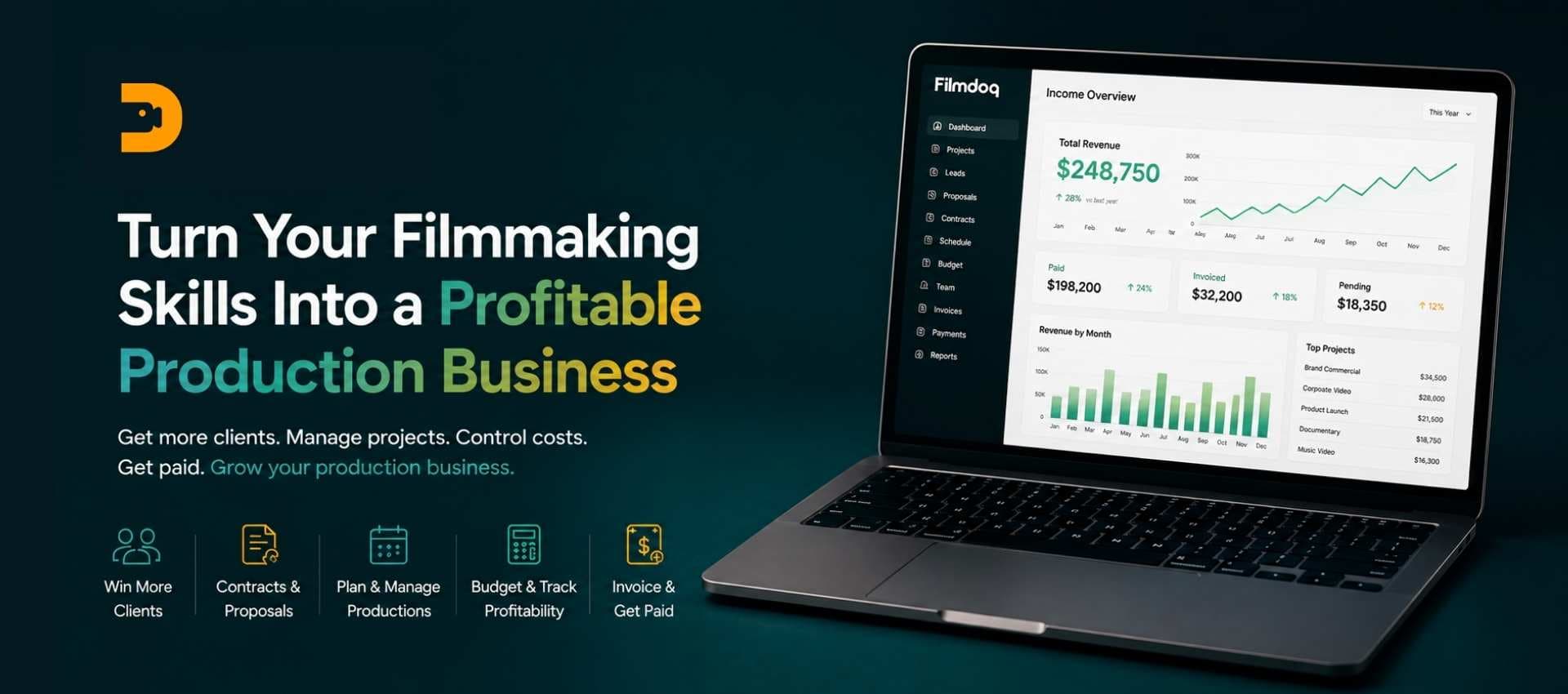
But once an opportunity becomes a real project, you need a system to turn that opportunity into recurring revenue and deliver it profitably. Filmdoq brings production planning, scheduling, contracts, budgets, collaboration, invoicing, payments, and other production workflows into one environment.
Instead of running your business across a collection of disconnected spreadsheets, documents, emails, messaging apps, calendars, and payment tools, you can organize the production around a central project workflow.
From Client Inquiry to Final Payment
Consider a filmmaker who receives a $5,000 corporate video opportunity.
Instead of immediately thinking:
"Great, I just made $5,000."
They can think:
1. What am I selling?
Define the service and deliverables.
2. What is the client agreeing to?
Create the proposal and production agreement.
3. What will this project cost?
Build the production budget.
4. What needs to happen?
Create the production plan, schedule, shot list, and other documents.
5. Who is involved?
Organize the production team and responsibilities.
6. How will the client pay?
Create the invoice and establish payment terms.
7. Did we actually make money?
Compare actual project costs against the original budget.
8. Can we do this again?
Document the workflow and turn the successful service into a repeatable offering.
That's a business process.
Your Production Documents Should Work Together
A production brief isn't just a document.
A budget isn't just a spreadsheet.
A contract isn't just a PDF.
A schedule isn't just a calendar.
A call sheet isn't just a PDF.
They are all pieces of the same project.
The brief defines what you're making.
The contract establishes what everyone agreed to.
The budget defines what the production should cost.
The schedule determines when the work happens.
The shot list defines what needs to be captured.
The call sheet communicates the production plan.
The invoice turns completed work into revenue.
When those pieces are disconnected, changes become difficult to manage.
If a client adds another deliverable, the scope changes.
That can affect the contract.
The budget may change.
The schedule may change.
The crew may need to change.
The invoice may change.
The production is connected. Your workflow should be connected too.
Stop Building Every Project From Scratch
One of the biggest advantages of building a production business is creating repeatable systems.
If you regularly produce:
Corporate videos
Music videos
Commercials
Social media content
Documentaries
Interviews
Photography campaigns
Events
Branded content
You shouldn't have to reinvent your workflow every time. Your contracts can follow templates.
Your budgets can follow standard structures.
Your production documents can use repeatable formats.
Your services can have defined deliverables.
Your pricing can be based on established packages.
Your production process can become a standard operating procedure.
The more repeatable the process becomes, the less the business depends on improvisation.
Build a Business That Can Handle More Than One Project
This is where the difference between self-employment and a business becomes very clear. If you have one project, you can probably manage it from your inbox, but if you have ten projects, multiple crew members, subcontractors, clients, invoices, expenses, and deadlines, disconnected tools become increasingly difficult to manage.
Filmdoq Production management software exists because production becomes more complex as it grows. Filmdoq platforms increasingly connect scheduling, budgeting, documents, crew coordination, invoicing, and other workflows instead of forcing teams to manage each area separately.
The Business Behind the Camera
Your camera is a tool.
Your editing software is a tool.
Your lighting equipment is a tool.
Your creative ability is your expertise.
But none of those things automatically create a business.
A business is the system that turns your expertise into something you can repeatedly sell, deliver, measure, and improve.
That system includes:
Marketing → Sales → Services → Budgeting → Contracts → Invoicing → Payment → Team→ Production → Delivery → Repeat Business
The goal isn't simply to get another gig. The goal is to build a machine that can consistently turn your creative skills into revenue and profit.
How to Build a More Consistent Filmmaking Income
There is no software that can guarantee you consistent clients, but you can make your business much more prepared to capitalize on the opportunities you do create.
Start with these fundamentals:
1. Define what you sell
Stop selling "video production" as an abstract service.
Define specific packages and outcomes.
2. Know your numbers
Understand your costs, pricing, gross margin, and actual project profitability.
3. Create a repeatable sales process
Move prospects through a consistent process from inquiry to quote, agreement, deposit, and production.
4. Use contracts
Clearly establish scope, deliverables, payment terms, revisions, responsibilities, and other important project conditions.
5. Standardize your production workflow
Don't reinvent your production process for every client.
6. Build repeat clients
A profitable business becomes much more predictable when satisfied clients return for additional work.
7. Track project performance
Know which services and projects actually make money.
8. Build systems that allow you to delegate
If every task requires you personally, your income will always be limited by your available time.
Filmdoq: The Business Infrastructure Behind Your Production Skills
The filmmaker of the future isn't necessarily the person with the most expensive camera. It's the person who can consistently turn their creative ability into a professional, profitable, repeatable service.
Filmdoq is built around that idea. You bring the creative skill, the vision, the relationships and clients, while Filmdoq helps provide the operational infrastructure around the work; from planning and production documents to budgets, contracts, collaboration, invoicing, and payments. Because getting paid to make a video is only the beginning. The real goal is building a production business that can keep making money from your skills.
You know how to create. Filmdoq helps you build the business behind it.
Start Building the Business Behind Your Production
If you're tired of managing productions through spreadsheets, scattered documents, emails, and disconnected apps, Filmdoq brings the essential parts of your production workflow into one place.
Plan your projects.
Manage your production.
Control your budget.
Organize your agreements.
Invoice your clients.
Get paid.
Build a workflow you can repeat.